aft — blog article 1 of 7 (_inbox/Blog article idea.txt)
Status: written, not yet reviewed by Dylan, not wired into any page. No blog nav item exists (D-030) — this is a standalone piece, publishable only where Dylan decides to link it from (the About page is the natural spot, or its own URL with no nav entry).
SEO fields
- Title tag (54 char):
Why Our Logo Is a Jellyfish: The Immortality Question - Meta description (155 char):
The “immortal jellyfish” can reverse its own aging. Here’s what the science actually shows, what it doesn’t, and why we picked it as our symbol. - Target query: “immortal jellyfish aging research” / “can jellyfish reverse aging”
- Slug:
/blog/why-a-jellyfish
Compliance check: no medical claims about humans, no promise of a cure, no Auralyp product claims. General-science content with a clearly marked opinion section at the end. Sourced to real, verifiable biology (PubMed / ScienceDirect / Forbes coverage, checked 2026-08-22) — nothing here is invented.
Revised 2026-08-26 per Dylan’s style notes (_inbox/website/design/blog/review blog.txt): shorter paragraphs, more “but”/”so” connectors, sharper title. Style reference: daedalium.com’s “price it bitch”. No factual or compliance changes.
Our logo is a jellyfish because, as far as biologists can tell, it’s the closest thing that exists to a biologically immortal animal. And almost nobody has studied how it works.
The animal that can undo its own age
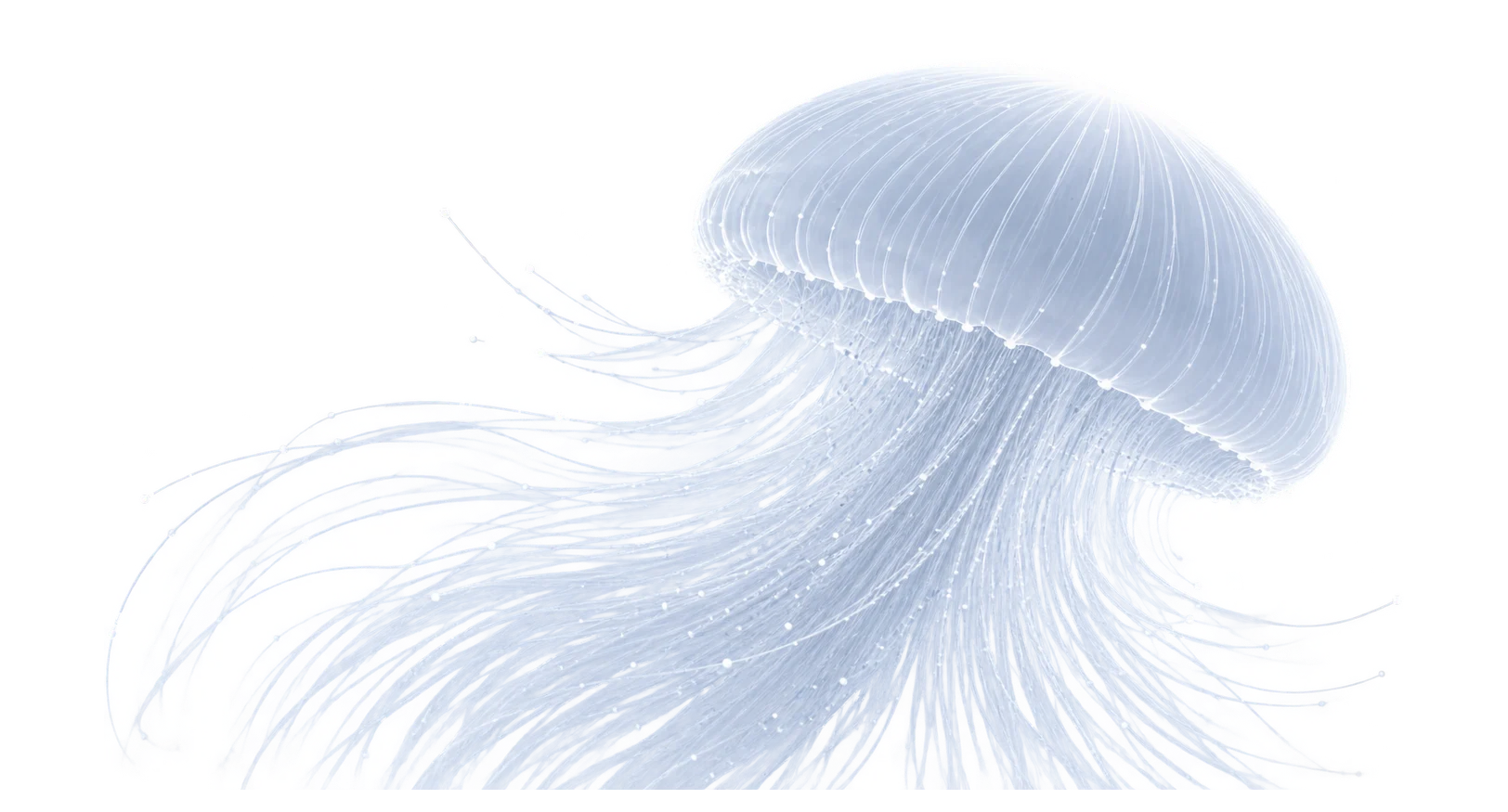
Turritopsis dohrnii is a species of small, bell-shaped jellyfish first described in the Mediterranean in 1883. For a century it looked unremarkable.
Then, in the 1990s, researchers documented something no other known animal does: when it’s injured, starved, or stressed, it doesn’t just heal. It doesn’t just die either. It can revert.
An adult Turritopsis is sexually mature, structurally complex, its cells already committed to being nerve cells, muscle cells, stinging cells. But instead of dying, it collapses back into a cyst — and the cyst regrows into a juvenile polyp, the same life stage the jellyfish started from as a newly settled larva.
It isn’t healing an injury. It’s undoing its own development and starting the clock over. In a lab, under the right conditions, a single jellyfish has been cycled through this more than once, which is the closest thing biology has to an organism aging backward on command.
How it does it — as far as anyone knows
The mechanism is called transdifferentiation: a fully specialized, mature cell converting directly into a different type of specialized cell, skipping the “blank slate” stem-cell stage most regeneration relies on. A muscle cell becoming a nerve cell. It’s closer to a butterfly turning back into a caterpillar than to a wound scabbing over.
Here’s the part that makes it more than a curiosity. Sequencing work on the jellyfish’s dormant cyst stage — the stage it collapses into mid-reversal — has found it strongly upregulates genes involved in telomere maintenance and DNA repair relative to its other life stages. That’s a real, published finding, and it’s a genuinely interesting one, because telomere shortening and DNA damage accumulation are two of the most-studied mechanisms in human aging research.
It isn’t proof the two things work the same way. It’s a clue pointing at where to look.
What the science doesn’t say
Here’s the honest part, and it’s the reason this article exists rather than a shorter, punchier version of it: nobody actually knows how this works, in enough detail to do anything with it.
The genes involved have been catalogued more than they’ve been explained. The number of labs actively working on this one species, worldwide, is small — small enough that a single researcher’s retirement can meaningfully slow the field down.
And Turritopsis dohrnii is one species out of an entire phylum most people have never heard of; there are other hydrozoans with life cycles nobody has looked at closely enough to know if they do something similar.
So no, this isn’t evidence a human treatment is coming. It’s evidence that a real, physical mechanism for reversing cellular age exists somewhere in nature, that we’ve only ever found it in one obscure animal, and that the number of scientists looking for it elsewhere is small.
That’s a genuinely interesting fact about the state of the science. But it isn’t a cause we’re positioned to champion — we’re not a research funder or a lab, and we’re not going to pretend otherwise. We just think it’s the right amount of humility for a company that put the animal on its own logo.
Why we chose it
We didn’t pick a jellyfish because we think we’re about to cure aging. We picked it because it’s an honest mascot for the gap we actually work in.
Nature has already solved a version of this problem, once, in an animal that will never write a paper about it. Human medicine hasn’t — not yet, and probably not soon.
In the meantime, the actual work of extending healthy human life happens somewhere much less glamorous than a marine biology lab: in the day-to-day operation of hormone and longevity clinics, run mostly by one or two people, fielding phone calls between patients. That’s the frontline that exists today, regardless of what a jellyfish can or can’t teach us.
That’s also, concretely, the business we’re in — not the research, the frontline. Auralyp builds the patient-response infrastructure that keeps those clinics answering every new patient who reaches out, so the ones doing this work today are still open and still seeing patients whenever the lab work catches up. More on why that’s the mission: our mission.
Sources: Regenerative characteristics of the immortal jellyfish, Turritopsis dohrnii, and their potential implications for human aging — ScienceDirect · Cellular Reprogramming and Immortality — PMC · Meet The Immortal Jellyfish That Can Reverse Its Own Aging Process — Forbes